The Agar Test and Bacteria Culture

The Agar Test

I completely forgot about this exciting experiment. I did this experiment 2 years ago, but I don’t know what to call it. I will call it… The bacteria experiment. This experiment is to let you culture (grow) bacteria. But I’m not going to do that experiment today. I wanted to check my agar.

Agar is a jelly-like substance, obtained from algae. Agar is derived from the polysaccharide agarose, which forms the supporting structure in the cell walls of certain species of algae, and which is released on boiling.

Simply, agar is the bacterias’ food. Let’s look at it.20170707_190853

I used half of it. I store it in my refrigerator and hid it deep in there so nobody can see it. If my mom sees that, it will be in the garbage bin because she doesn’t like chemicals to be with food. Anyway, I’m going to check it to make sure that it works properly. Wait, what’s this?20170707_190901

Expires on September 10th 2015?

This would not work. But I hid it so well though 😂.

And store it at 2-8°C (36-46°F)? My ‘fridge is only 10°C.

This can’t work. But you know, it may work.

It’s still frozen, so I’m going to boil the whole bottle if I remember 2 years ago. I need to clean everything, even the container that it’s going to be boiled in. I don’t want it to be contaminated.

To do the test you’ll need:

Things you’ll need: 2 petri dishes, beaker, alcohol lamp, agar, gloves, towels, and Q-tips.

Warning: Make sure everything is clean.

  1. Boil the whole bottle of agar in the beaker. The agar will turn into liquid.20170708_092615
  2. Pour the agar into the petri dishes; half way.20170708_102827
  3. Use a Q-tip to collect bacteria. Rub it on dirty things (I used a shoe).
  4. Rub the Q-tip that is dirty on to one petri dish. Leave the other one alone.20170708_103632
  5. Place it in a dark place, cover it with half way a petri dish lid, and wait for 2-3 days.

If the dirty petri dish has dots on it and the other one doesn’t, your agar is fine.

If the dirty petri dish has nothing on it, the agar is bad.

But it looks like that it’s fine.20170709_182657.jpg
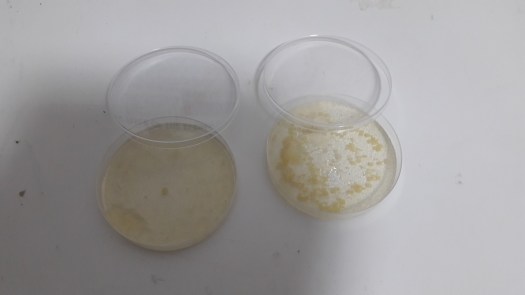
The clean one is one the left and the dirty is on the right.20170709_182703.jpg

The result is: my agar is fine.


How can the Glass Catfish be Transparent?

How can is the Glass Catfish be Transparent?

You’ve probably heard about this fish. But if you don’t know what the fish looks like I’ll tell you how it looks like. Anyway, I wrote this post because I was wondering why is it transparent. The answer will be below.

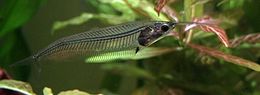
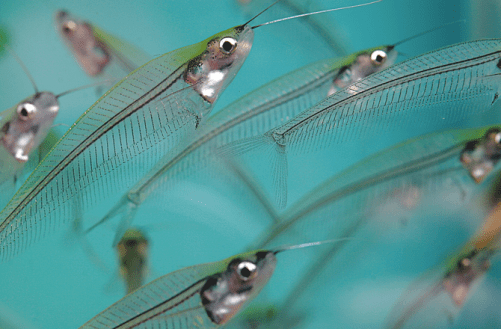
Kryptopterus vitreolus, known in the aquarium trade traditionally as the glass catfish and also as the ghost catfish or phantom catfish, is a small species of Asian glass catfish. It is commonly seen in the freshwater aquarium trade, but its taxonomy is confusing and was only fully resolved in 2013. It is endemic to Thailand, where found in rivers south of the Isthmus of Kra that drain into the Gulf of Thailand and river basins in the Cardamom Mountains. There are also unconfirmed reports from Penang in Malaysia.


Kryptopterus.jpg
A Glass Catfish

Until 1989, it was considered to be the same as the “glass catfish” Kryptopterus bicirrhis, a larger species infrequently seen in the aquarium trade. Subsequently, the ghost catfish commonly seen in the aquarium trade was believed to be the same as K. minor, but in 2013 it was established that the aquarium specimens actually represented another species, which was described as K. vitreolus. The true K. minor, which is restricted to Borneo, has rarely (if ever) entered the aquarium trade.

But how is it transparent?

This is a question for which there is no satisfactory answer, because we are only beginning to understand the physical and anatomical basis of transparency in living tissue.

Although the physical and anatomical bases for some transparent tissue (e.g. the cornea and lens in the eye) are better understood than others, the situation in the eye is unique in the sense that the tissues are highly modified for transparency and these modifications (e.g. complete absence of a circulatory system) are not applicable to muscular tissue.
amyc0eezg.png

Furthermore, many of the primary modifications for transparency are ultrastructural and can only be seen with an electron microscope. For biological tissue to become transparent, the primary mechanism is to reduce the amount of light being scattered as it passes through it: the less light scattered by the tissue, the more light will be transmitted through it and the more it becomes transparent.

While we do not yet fully understand how biological tissues (particularly muscles) can be transparent, there are several possible mechanisms which might contribute.  The first is that transparent fishes such as glass catfishes and glassfish have very thin bodies.  The flatter the body, the less the potential scattering of light (and hence the easier it is to make the tissue transparent).

Another possible mechanism is the ordered packing of small molecules within the cytoplasm of the cells to reduce the scattering of light.

Lastly, theoretical models also predict that the many subcellular components of transparent tissues (e.g. mitochondria, ribosomes) should be small and highly dispersed. As a recent review paper on biological transparency states, this field of study has more questions than answers, and we await future studies to fully understand this phenomenon.


Leaf Fish

Leaf Fish

Do you know what camouflage is? Camouflage is the use of any combination of materials, coloration, or illumination for concealment, either by making animals or objects hard to see (crypsis), or by disguising them as something else (mimesis). Examples include the leopard’s spotted coat, the battledress of a modern soldier, and the leaf-mimic katydid‘s wings. A third approach, motion dazzle, confuses the observer with a conspicuous pattern, making the object visible but momentarily harder to locate. The majority of camouflage methods aim for crypsis, often through a general resemblance to the background, high contrast disruptive coloration, eliminating shadow, and countershading. In the open ocean, where there is no background, the principal methods of camouflage are transparency, silvering, and countershading, while the ability to produce light is among other things used for counter-illumination on the undersides of cephalopods such as squid. Some animals, such as chameleons and octopuses, are capable of actively changing their skin pattern and colours, whether for camouflage or for signalling.

Some animals camouflage in the ocean like the rockfish or flounders. But in my opinion, this one would be the best. It is called the “leaf fish”.
Monocirrhus polyacanthus.jpg

Leaffishes are small freshwater fishes of the Polycentridae family, from South America.

All of these fishes are highly specialized ambush predators that resemble leaves, down to the point that their swimming style resembles a drifting leaf (thus the common name leaf fish, which is shared with old world fishes of family Nandidae with a similar lifestyle); when a prey animal – such as an aquatic insect or smaller fish – comes within range, the fish attacks, swallowing the prey potentially within a quarter of a second. To aid in this lifestyle, all members of the family have large heads, cryptic colors and very large protractile mouths capable of taking prey items nearly as large as they are. These intriguing behaviors have given the family a niche in the aquarium hobby; however, none of these species are easy to maintain in aquariums, requiring very clean, soft, acidic water and copious amounts of live foods.

Walking Fishes

 Walking Fishes

Can fishes walk on land? Sounds crazy! But these two fish can.

1.  Mudskippers are amphibious fish, presently included in the subfamily Oxudercinae, within the family Gobiidae (gobies). Recent molecular studies do not support this classification, as oxudercine gobies appear to be paraphyletic relative to amblyopine gobies (Gobiidae: Amblyopinae), thus being included in a distinct “Periophthalmus lineage”, together with amblyopines. Mudskippers can be defined as oxudercine gobies that are “fully terrestrial for some portion of the daily cycle” (character 24 in Murdy, 1989). This would define the species of the genera Boleophthalmus, Periophthalmodon, Periophthalmus, and Scartelaos as “mudskippers”. However, field observations of Zappa confluentus suggest that this monotypic genus should be included in the definition. These genera presently include 32 species. Mudskippers use their pectoral fins and pelvic fins to walk on land. They typically live in intertidal habitats, and exhibit unique adaptations to this environment that are not found in most intertidal fishes, which typically survive the retreat of the tide by hiding under wet seaweed or in tide pools.

Mudskippers are quite active when out of water, feeding and interacting with one another, for example, to defend their territories and court potential partners. They are found in tropical, subtropical, and temperate regions, including the Indo-Pacific and the Atlantic coast of Africa.


GambianMudskippers.jpg
Mudskippers

2. Climbing Perch

The Anabantidae are a family of perciform fish commonly called the climbing gouramies or climbing perches. The family includes about 34 species. As labyrinth fishes, they possess a labyrinth organ, a structure in the fish’s head which allows it to breathe atmospheric oxygen. Fish of this family are commonly seen gulping at air at the surface of the water. The air is held in a structure called the suprabranchial chamber, where oxygen diffuses into the bloodstream via the respiratory epithelium covering the labyrinth organ. This therefore allows the fish to move small distances across land.


download
Climbing  Gourami on land
Of the four genera, Anabas is found from South Asia (they are called chemballi (Malayalam: urulan sugu/Karippidi) in Kerala, kau (odia) in Odisha, India, kawaiya in Sri Lanka), east to China and Southeast Asia. The remaining three genera are all restricted to Africa. They are primarily freshwater fishes and only very rarely are found in brackish water. As egg-layers, they typically guard their eggs and young.

Climbing gouramis are so named due to their ability to “climb” out of water and “walk” short distances. Even though it is not reliably observed, some authors mentioned about they having a tree climbing ability. Their method of terrestrial locomotion uses the gill plates as supports, and the fish pushes itself using its fins and tail.

Mudskipper video

Climbing Perch video