(DIY) How to make Ring + Stands for Test Tubes and Funnels

(DIY) How to make Ring + Stands for Test Tubes and Funnels

20170802_17285220170802_17295720170802_173019

I need a test tube ring and stand for this experiment, but I don’t have one. The chemical shop doesn’t have it either. I went to my laptop and looked at my online science supplier, but it’s too expensive. Then there’s only one way… Do it yourself! This is my idea. So in post, I’m going to show you step-by-step how to make ring stands for test tubes and funnels. Let’s get started!

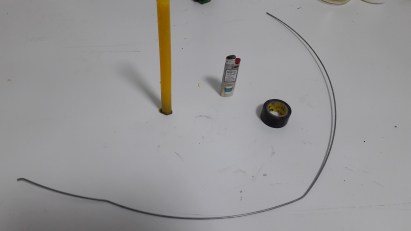
Things you’ll need: Strong wire, a candle, lighter, scissors, forceps, and electrical tape.
 

20170802_173143
Some things are not in this photo.


1. Planning:

Of course, the first step of a project is planning. The whole stand was made by me (I designed it by myself). In this step, you just need to design your own stand.

If you want to have the exact same stand that I have, just follow the picture below.
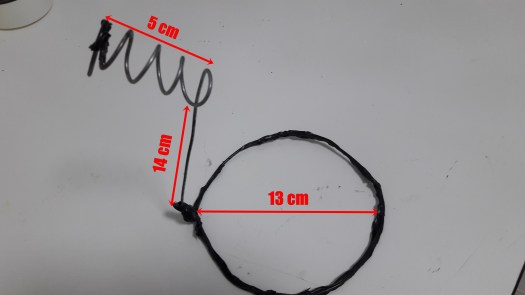
20170802_173211

2. Making the base:

Make a circle with the wire and make sure to leave an end on both sides (one long one short). 20170802_173609

3. Making the circle:

Wrap the end of the circle around the longer end. Now try to stand it up, and make some changes to balance it.

20170802_174051

5. Making the ring:

Use the long end to make a ring. This depends on what you want to hold, and make sure it’s balanced by putting some weight on it.
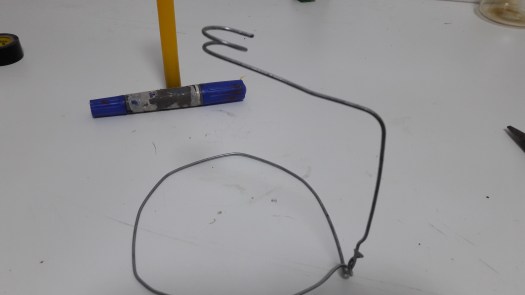
20170802_174930

6. Wrapping the tape:

Electrical is just like rubber. You need to make the stand “not slipping around the table”. So put tape on the base and the ring. It looks messy but you’ll fix later.20170802_175812

7. Burning:

Melt the tape with a candle onto the metal. This will make the tape look cleaner and stronger.


8. Squeezing the tape:

While the tape is still soft, squeeze it with forceps. This will make the tape stick onto the metal.

9. Cleaning up the tape:

Use scissors to cut the excess off the tape. Mine is messy but if you put more effort into it, I’m sure that it’ll neater.20170802_180722
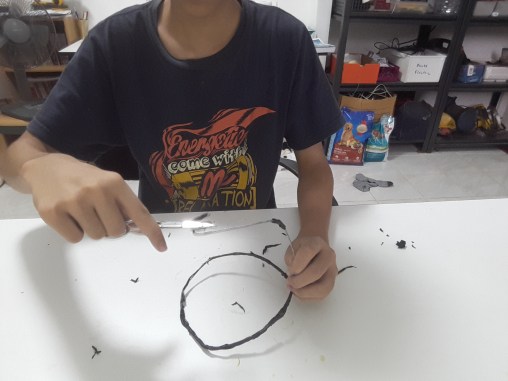
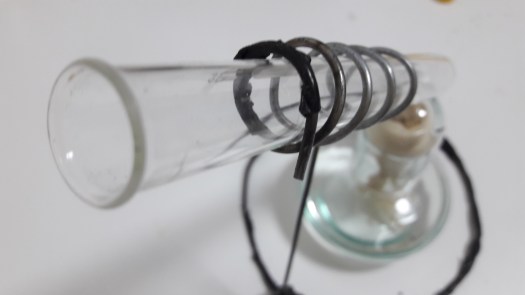
Finished. Test it and make sure nothing falls off the ring. Unfortunately, my wire is too short so I decided to make it a funnel holder.

This is one method of making a test tube or funnel holder, but I’m sure there’s more floating around.

Did you like my method? Feel free to comment down below ↓
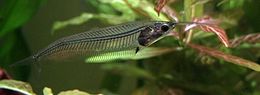
How can the Glass Catfish be Transparent?

How can is the Glass Catfish be Transparent?

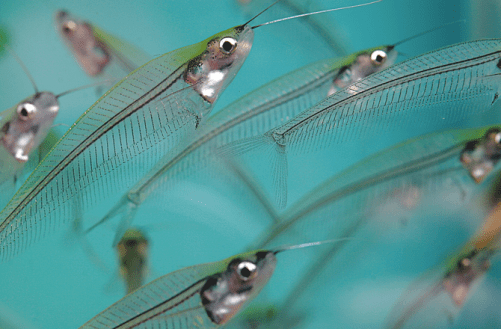
You’ve probably heard about this fish. But if you don’t know what the fish looks like I’ll tell you how it looks like. Anyway, I wrote this post because I was wondering why is it transparent. The answer will be below.

Kryptopterus vitreolus, known in the aquarium trade traditionally as the glass catfish and also as the ghost catfish or phantom catfish, is a small species of Asian glass catfish. It is commonly seen in the freshwater aquarium trade, but its taxonomy is confusing and was only fully resolved in 2013. It is endemic to Thailand, where found in rivers south of the Isthmus of Kra that drain into the Gulf of Thailand and river basins in the Cardamom Mountains. There are also unconfirmed reports from Penang in Malaysia.


Kryptopterus.jpg
A Glass Catfish

Until 1989, it was considered to be the same as the “glass catfish” Kryptopterus bicirrhis, a larger species infrequently seen in the aquarium trade. Subsequently, the ghost catfish commonly seen in the aquarium trade was believed to be the same as K. minor, but in 2013 it was established that the aquarium specimens actually represented another species, which was described as K. vitreolus. The true K. minor, which is restricted to Borneo, has rarely (if ever) entered the aquarium trade.

But how is it transparent?

This is a question for which there is no satisfactory answer, because we are only beginning to understand the physical and anatomical basis of transparency in living tissue.

Although the physical and anatomical bases for some transparent tissue (e.g. the cornea and lens in the eye) are better understood than others, the situation in the eye is unique in the sense that the tissues are highly modified for transparency and these modifications (e.g. complete absence of a circulatory system) are not applicable to muscular tissue.
amyc0eezg.png

Furthermore, many of the primary modifications for transparency are ultrastructural and can only be seen with an electron microscope. For biological tissue to become transparent, the primary mechanism is to reduce the amount of light being scattered as it passes through it: the less light scattered by the tissue, the more light will be transmitted through it and the more it becomes transparent.

While we do not yet fully understand how biological tissues (particularly muscles) can be transparent, there are several possible mechanisms which might contribute.  The first is that transparent fishes such as glass catfishes and glassfish have very thin bodies.  The flatter the body, the less the potential scattering of light (and hence the easier it is to make the tissue transparent).

Another possible mechanism is the ordered packing of small molecules within the cytoplasm of the cells to reduce the scattering of light.

Lastly, theoretical models also predict that the many subcellular components of transparent tissues (e.g. mitochondria, ribosomes) should be small and highly dispersed. As a recent review paper on biological transparency states, this field of study has more questions than answers, and we await future studies to fully understand this phenomenon.