What Happened to the Sulfur Coin? (Sulfur science and can the coin melt again?)
The coin:
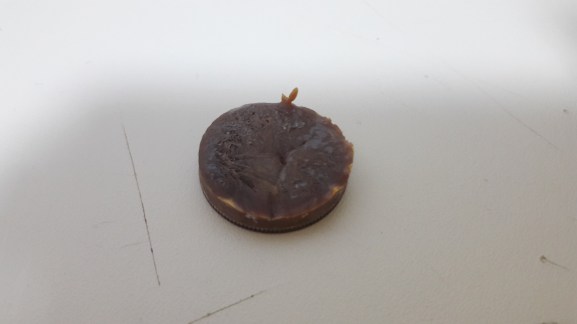
Now, what happened to that coin? It was 10 days since I made it, and I wanted to show you what happened. Here’s the coin: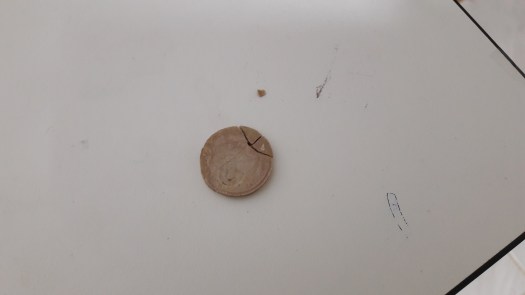
The coin has turned white and it came apart into a couple pieces… I guess it’s useless now, but I was wondering, can I melt it again? Let’s try it.
Can we melt it again:
Yes! Look at this:
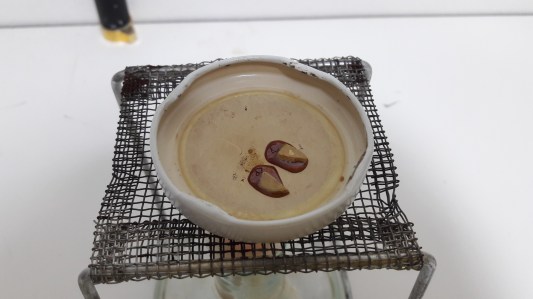
It’s melting just fine. It started melting in ten seconds (very quick). I’m guessing you could melt it as many times as you want just like the other metals.
Sulfur Science:
Why does yellow sulfur turn black when heated?
The internal structure of sulfur changes under heating. From stable at room temperature crystalline form of yellow color it turns into its plastic form, which has no specific internal structure. This changes the color of the substance: initially yellow sulfur becomes red-brown, and then black.
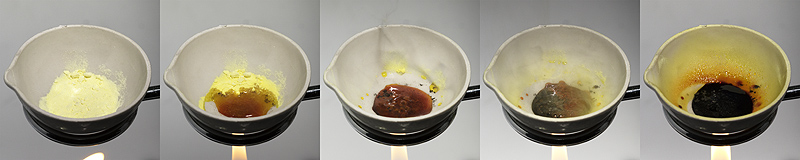
When heated above 119oC sulfur crystals melt and form a reddish-orange liquid, also consisting of S8 molecules. At temperatures even higher the sulfur ring molecules break, forming “strings” of atoms linked with one another. Exactly the occurrence of linear molecules makes molten sulfur black. These “strings” can bond their free ends to each other, forming very long molecules. As a result, the liquid sulfur thickens due to the “clumsiness” of large molecules. They can be compared to threads: the greater their length, the easier they get tangled with each other. If the black viscous liquid is heated to 187oC, it will become maximally dense (plastic sulfur). At temperatures higher yet still, the bonds in long molecules are destroyed once again, and the mass becomes thinner. Maximally runny black sulfur becomes at 400oC, and boils at 445oC.
Why does the coin change its color over time?
A substance always aims to take its most stable form. Black plastic sulfur is not stable under normal conditions. Therefore, it gradually changes its internal structure, crystallizes and turns into yellow rhombic sulfur.
The black figurine is made of very long molecules of sulfur Sn. Such an internal structure of the substance is stable only at high temperature. It can be temporarily stabilized only by quick cooling. At room temperature, long molecules gradually “break”, and their fragments form ring molecules S8. The latter form crystals of rhombic sulfur, which is the only allotropic modification of sulfur, stable at room temperature. In addition to color change, changes in other physical properties also occur. The figurine becomes fragile and eventually shatters. This process cannot be prevented, but it is very interesting to watch.
The coin turned yellow and crumbled in a couple days
Well, nothing is actually wrong here. Sulfur crystallization is a complicated process. The time it takes is mostly determined by the temperatures the substance was subjected to initially.“
Source:
https://melscience.com/en/experiments/sulfur-melt/




 Danupon Drake