How to make the Surface of the Moon
The Moon is an astronomical body that orbits planet Earth, being Earth’s only permanent natural satellite. It is the fifth-largest natural satellite in the Solar System, and the largest among planetary satellites relative to the size of the planet that it orbits (its primary). Following Jupiter’s satellite Io, the Moon is second-densest satellite among those whose densities are known.
The average distance of the Moon from the Earth is 384,400 km (238,900 mi), or 1.28 light-seconds.
The Moon is thought to have formed about 4.51 billion years ago, not long after Earth. There are several hypotheses for its origin; the most widely accepted explanation is that the Moon formed from the debris left over after a giant impact between Earth and a Mars-sized body called Theia.
The Moon is in synchronous rotation with Earth, always showing the same face, with its near side marked by dark volcanic maria that fill the spaces between the bright ancient crustal highlands and the prominent impact craters. It is the second-brightest regularly visible celestial object in Earth’s sky, after the Sun, as measured by illuminance on Earth’s surface. Its surface is actually dark, although compared to the night sky it appears very bright, with a reflectance just slightly higher than that of worn asphalt. Its prominence in the sky and its regular cycle of phases have made the Moon an important cultural influence since ancient times on language, calendars, art, and mythology.
The Moon’s gravitational influence produces the ocean tides, body tides, and the slight lengthening of the day. The Moon’s current orbital distance is about thirty times the diameter of Earth, with its apparent size in the sky almost the same as that of the Sun, resulting in the Moon covering the Sun nearly precisely in total solar eclipse. This matching of apparent visual size will not continue in the far future. The Moon’s linear distance from Earth is currently increasing at a rate of 3.82 ± 0.07 centimetres (1.504 ± 0.028 in) per year, but this rate is not constant.
The Soviet Union’s Luna programme was the first to reach the Moon with uncrewed spacecraft in 1959; the United States’ NASA Apollo program achieved the only crewed missions to date, beginning with the first crewed lunar orbiting mission by Apollo 8 in 1968, and six crewed lunar landings between 1969 and 1972, with the first being Apollo 11. These missions returned over 380 kg (840 lb) of lunar rocks, which have been used to develop a geological understanding of the Moon’s origin, the formation of its internal structure, and its subsequent history. Since the Apollo 17 mission in 1972, the Moon has been visited only by uncrewed spacecraft.
Now, after we know what the moon is, let’s make the surface.
Things you’ll need: plaster dust, a deep plate, small rocks, forceps, and a sprayer.
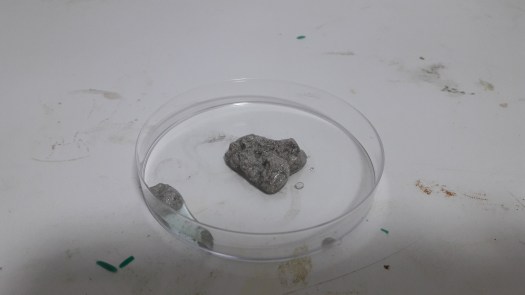
- Pour the plaster dust onto the plate and spread it around. This is the surface of the moon.
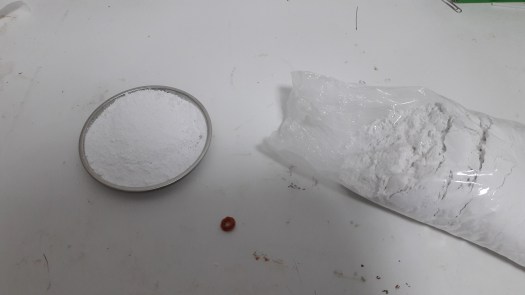
- Drop the rocks on the plate carefully. The rocks are meteors.
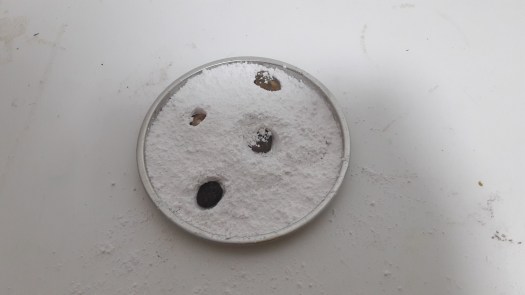
- Use the forceps to take the rocks out.
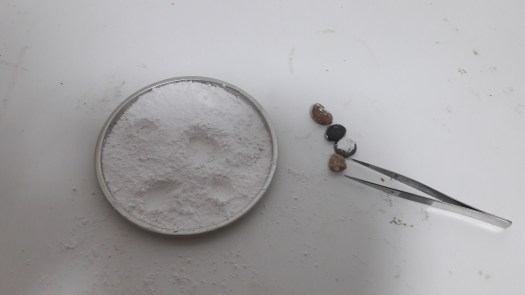
- Spary some water on it. Now you have a moon surface.

A permanent asymmetric moon dust cloud exists around the Moon, created by small particles from comets. Estimates are 5 tons of comet particles strike the Moon’s surface each 24 hours. The particles strike the Moon’s surface ejecting moon dust above the Moon. The dust stays above the Moon approximately 10 minutes, taking 5 minutes to rise, and 5 minutes to fall. On average, 120 kilograms of dust are present above the Moon, rising to 100 kilometers above the surface. The dust measurements were made by LADEE’s Lunar Dust Experiment (LDEX), between 20 and 100 kilometers above the surface, during a six-month period. LDEX detected an average of one 0.3 micrometer moon dust particle each minute. Dust particle counts peaked during the Geminid, Quadrantid, Northern Taurid, and Omicron Centaurid meteor showers, when the Earth, and Moon, pass through comet debris. The cloud is asymmetric, more dense near the boundary between the Moon’s dayside and nightside






 Danupon Drake