Color Change Chemistry

Color Change Chemistry

Change a clear liquid pink, then back to clear again in this impressive experiment. It may seem like magic, but it’s actually the science of PH.

Things you’ll need: a beaker, a graduated cylinder, test tube holder, 3 test tubes, pipet, phenolphthalein, sodium carbonate, vinegar, and water.20170613_163519

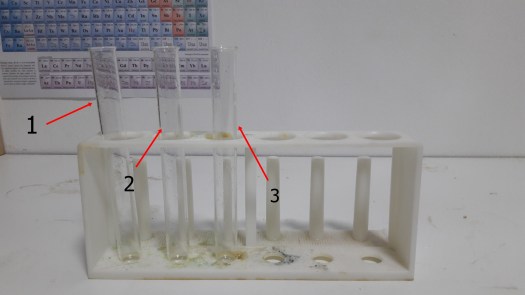
  1. Fill the beaker halfway with water, and set the test tubes in the holder. I’ll refer to them in order as test tube 1, 2, and 3.20170613_163623
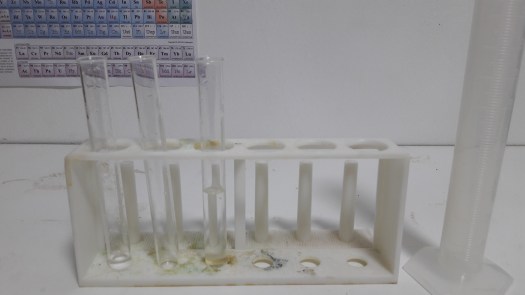
  2. Use a spoon to put a little bit of sodium carbonate in test tube 1.Use the pipet to add a few drops of water from the beaker. Swirl the test tube around to dissolve.20170613_164027
  3. In test tube 2, put two drops of phenolphthalein.20170613_164150
  4. Use the graduated cylinder to add 10 ml of vinegar to test tube 3.
  5. Carefully fill the first two test tubes with water from the beaker. Then, all at once, pour the contents of test tube 1 and 2  back into the beaker. The water will turn pink.20170613_164252
  6. Now pour the contents of test tube 3 into the beaker. the liquid will now be clear again. 

Phenolphthalein is a PH indicator that changes color when mixed with a base  (like sodium carbonate) but stays clear when mixed with an acid (like vinegar). In step 5, the phenolphthalein reacted to the basic sodium carbonate and turned the solution pink. To change it back to clear, you added acidic vinegar, neutralizing the basic sodium carbonate.

Learn more about phenolphthalein at this post: Invisible ink

Density Column

Density Column

Let’s start off with an easy experiment today. Create a colorful column with three liquids stacked on top of each other inside a test tube.

Things you’ll need: test tubes, pipet, food coloring, light or dark corn syrup, vegetable oil, and water.

  1. Pour about 3 ml of corn syrup into the test tube.20170608_164615
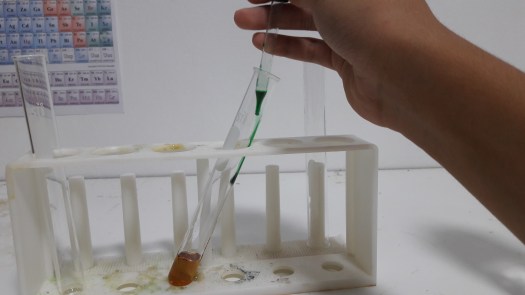
  2. Use a pipet to add 3 ml of water with food coloring (I use green). Make sure to drop the water on the side of the test tube.20170608_164940
  3. Do the same thing with vegetable oil but no water and food coloring.
  4. Observe the column you made. Which liquid is the least dense? Which is most dense? You could say that the liquid on the bottom has higher density. It means that the corn syrup has a high density. Medium density is water. And the vegetable oil has low density.

    20170608_165506
    My density column.
  5. What will happen if you add other liquids? Try adding apple juice, vinegar, soda, etc. You could also follow the column on the bottom.download

An object’s density is determined by comparing its mass to its volume. Consider a rock and a cork that are the same sizes; the rock is denser than the cork, because it has more mass in the same volume. This is due to the atomic structure of the elements, molecules, and componds that make it up. The same is true for liquids. Although you added approximately the same volume of each liquid, they all had different densities, based on mass per volume. Water has a density of about 1.0 gram per ml of volume. Matter with higher density will sink in water; matter with lower density will float on top. Calculate the approximate density of other liquids using this formula: Density= Mass/Volume. Measure mass by calculating weight (how heavy it is). Weigh each liquid in grams (subtracting the weight of your container), the divide that number by the liquid’s volume (ml). The answer is density in grams per milliliter.

See also: The Floating Needle Experiment

Swirling Colors

Swirling Colors

Can you make colors move in milk? Then perform this experiment.

20170514_155028

Things you’ll need: whole milk, a shallow dish, food coloring, and liquid dish soap.

1. Pour whole milk into the shallow dish.20170514_1550402. Let the milk warm up to room temperature.
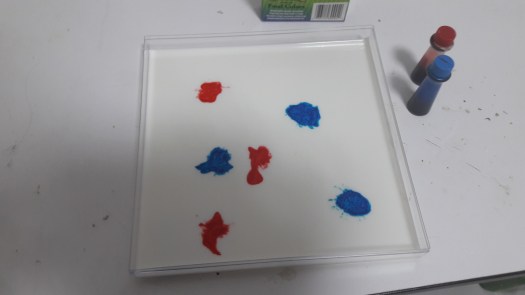
3. Place drops of different food coloring in the milk. DO NOT STIR.

20170514_160304

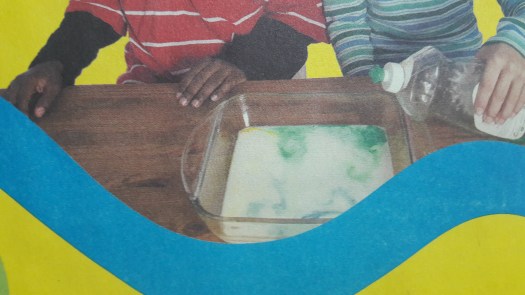
4. Place 1-3 drops of liquid dish soap in the middle of the dish. Enjoy the show!


The colors move as the soap spreads across the surface of the milk. Once soap covers the surface, the swirling will stop instantly (if you use water).

In whole milk, fat is the secret ingredient that keeps the colors move. As the soap spreads out, it sticks to tiny globules of fat. As the globules take up soap, they make more room for soap to spread out.