How to Calculate Molar Mass
Moles are a unit of measurement of chemicals. A mole is the atomic weight of a molecule of the chemical in grams and it is used very commonly in chemistry, so I’m going to show you how to calculate molar mass.
You can find the molar mass right on the periodic table. On the table, there is the element symbol, the atomic number, and the molar mass.
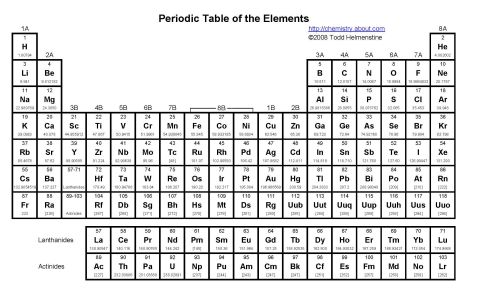
Here I’ve got some elements:


Nitrogen’s molar mass is 14.0067 g/mol, for oxygen, it’s 15.9994 g/mol, and for silver, it’s 107.8682 g/mol.
The first method of finding the molar mass is to look right on the table (just like I did).
The second method is to add up the masses of each atom (.Add up the masses of the atoms that form the compound) I’ll show how with the chemical silver nitrate.
AgNO3
One Silver molecule: 107.8682 + one Nitrogen molecule 14.0067 + and three molecules of Oxygen: (15.9994 x 3)
107.8682 + 14.0067 + (15.9994 x 3) = 169.8731
AgNO3 = 169.87 g/mol
Let’s try another one:
NaOH
One Sodium molecule: 22.989769 + One Oxygen: 15.9994 + and one Hydrogen: 1.00794
22.989769 + 15.9994 + 1.00794 = 39.997 g/mol
NaOH = 39.997 g/mol
H2SO4
Two Hydrogens: (2 x 1.00794) + One Sulfur: 32.07 + Four Oxygens: (4 x 16.00)
(2 x 1.00794) + 32.07 + (4 x 15.9994) = 98.079 g/mol
H2SO4 = 98.079 g/mol
I hope you understand, leave a comment if you have any questions or if there are any mistakes ↓
Sources:
http://www.qrg.northwestern.edu/projects/vss/docs/propulsion/3-what-is-a-mol.html
 Danupon Drake