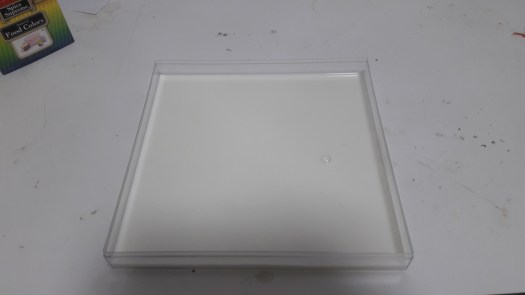
Elephant’s Toothpaste

Elephant’s toothpaste

Today I’m going to do this common experiment that is used in chemistry classes called the elephant’s toothpaste. Elephant’s toothpaste is a foamy substance caused by the rapid decomposition of hydrogen peroxide. This is often used for classroom demonstrations because it requires only a small number of ingredients and makes a “volcano of foam”.

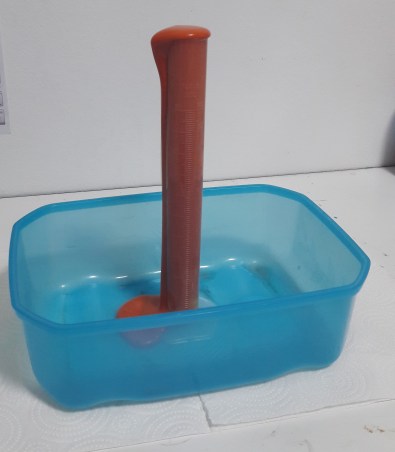
Things you’ll need: a plastic container (as shown on the picture), potassium iodide, food coloring, latex gloves, dishwasher soap, hydrogen peroxide 6%, and a graduated cylinder.

  1. Place the graduated cylinder in the middle of the plastic container (it will be very messy so prepare some paper towels).20170626_124640
  2. Wear the latex gloves and pour 50 ml of hydrogen peroxide into the graduated cylinder.
  3. Pour food coloring and dishwasher soap into the graduated cylinder.20170626_124849
  4. Put 2 grams of potassium iodide. The reaction will start.20170626_124945

This is a fun experiment. You could see the liquid just flows out nicely.20170626_124947
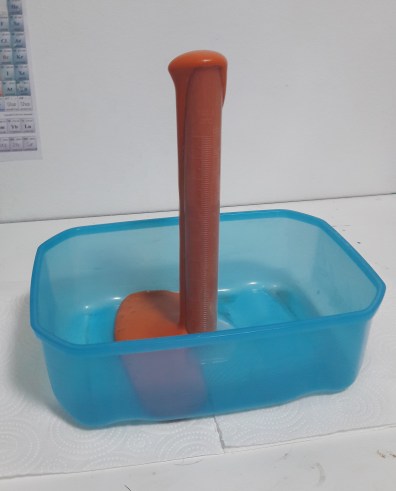
The reaction ended in about 30 seconds. Very fun for young kids.

20170626_125355

Concentrated (>30%) hydrogen peroxide is first mixed with liquid soap. Then a catalyst, often potassium iodide or catalase from baker’s yeast, is added to make the hydrogen peroxide decompose very quickly. Hydrogen peroxide breaks down into oxygen and water. As a small amount of hydrogen peroxide generates a large volume of oxygen, the oxygen quickly pushes out of the container. The soapy water traps the oxygen, creating bubbles, and turns into foam. Often some food coloring is also added before the catalyst to spice up the experiment, and make it more colorful and fun.

This experiment shows the catalyzed decomposition of hydrogen peroxide. Hydrogen peroxide (H2O2) decomposes into water and oxygen gas, but normally the reaction is too slow to be easily perceived or measured:

{\displaystyle {\ce {2H2O2->{2H2O}+O2{\uparrow }}}}

The iodide ion from potassium iodide acts as a catalyst—it speeds up the reaction without being consumed in the reaction process. The reaction is exothermic; the foam produced is hot. A glowing splint can be used to show that the gas produced is oxygen.

Source: https://en.wikipedia.org/wiki/Elephant%27s_toothpaste

Color Change Chemistry

Color Change Chemistry

Change a clear liquid pink, then back to clear again in this impressive experiment. It may seem like magic, but it’s actually the science of PH.

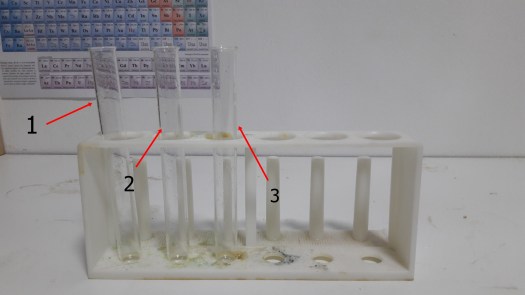
Things you’ll need: a beaker, a graduated cylinder, test tube holder, 3 test tubes, pipet, phenolphthalein, sodium carbonate, vinegar, and water.20170613_163519

  1. Fill the beaker halfway with water, and set the test tubes in the holder. I’ll refer to them in order as test tube 1, 2, and 3.20170613_163623
  2. Use a spoon to put a little bit of sodium carbonate in test tube 1.Use the pipet to add a few drops of water from the beaker. Swirl the test tube around to dissolve.20170613_164027
  3. In test tube 2, put two drops of phenolphthalein.20170613_164150
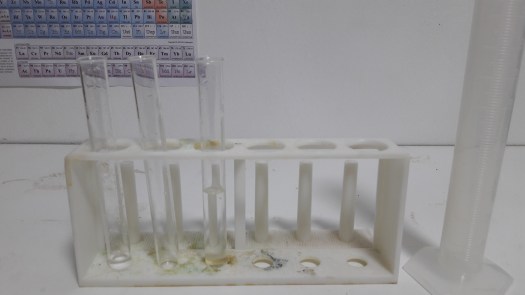
  4. Use the graduated cylinder to add 10 ml of vinegar to test tube 3.
  5. Carefully fill the first two test tubes with water from the beaker. Then, all at once, pour the contents of test tube 1 and 2  back into the beaker. The water will turn pink.20170613_164252
  6. Now pour the contents of test tube 3 into the beaker. the liquid will now be clear again. 

Phenolphthalein is a PH indicator that changes color when mixed with a base  (like sodium carbonate) but stays clear when mixed with an acid (like vinegar). In step 5, the phenolphthalein reacted to the basic sodium carbonate and turned the solution pink. To change it back to clear, you added acidic vinegar, neutralizing the basic sodium carbonate.

Learn more about phenolphthalein at this post: Invisible ink

Swirling Colors

Swirling Colors

Can you make colors move in milk? Then perform this experiment.

20170514_155028

Things you’ll need: whole milk, a shallow dish, food coloring, and liquid dish soap.

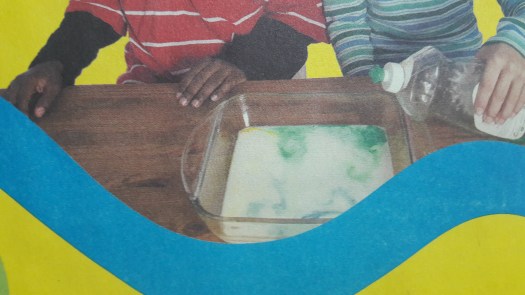
1. Pour whole milk into the shallow dish.20170514_1550402. Let the milk warm up to room temperature.
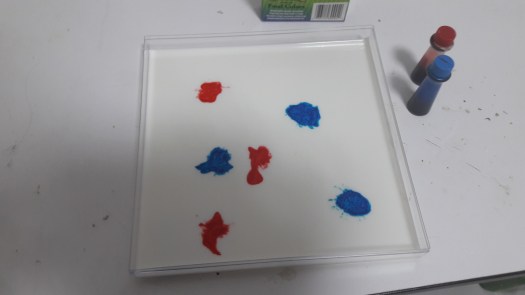
3. Place drops of different food coloring in the milk. DO NOT STIR.

20170514_160304

4. Place 1-3 drops of liquid dish soap in the middle of the dish. Enjoy the show!


The colors move as the soap spreads across the surface of the milk. Once soap covers the surface, the swirling will stop instantly (if you use water).

In whole milk, fat is the secret ingredient that keeps the colors move. As the soap spreads out, it sticks to tiny globules of fat. As the globules take up soap, they make more room for soap to spread out.