Separating Salt out of Water
Salt (NaCl) is a natural mineral made up of white cube-shaped crystals composed of two elements, sodium, and chlorine. It is translucent, colorless, odorless (officially, though we think you can smell the freshness of the sea in one of our boxes) and has a distinctive and characteristic taste. Salt occurs naturally in many parts of the world in mineral form and has been mined for thousands of years. Chemically, sea salt is the same.
Gastronomically, it’s very different. I’m going to show you how salt can be separated out of water.
Things you’ll need: a beaker, water, salt (ocean water would be better), and an alcohol lamp.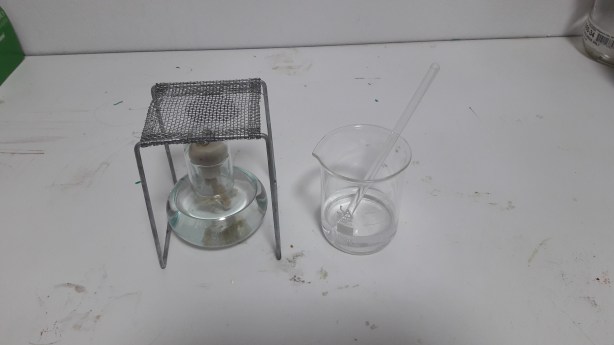
- Mix 50 ml water with 19 grams of salt together, stir the solution until dissolve.
- Light the alcohol lamp and place the beaker on the stand.

- Wait until the water is all gone (don’t let the salt be in there for too long, or it will burn)
Here’s my salt. It’s fluffy and soft like snow when I touched it.
I wish I could weigh it and see the difference from where I started.
Salt evaporation ponds, also called salterns, salt works or salt pans, are shallow artificial ponds designed to extract salts from sea water or other brines. The seawater or brine is fed into large ponds and water is drawn out through natural evaporation which allows the salt to be subsequently harvested. The ponds also provide a productive resting and feeding ground for many species of waterbirds, which may include endangered species. The ponds are commonly separated by levees.
Natural salt pans are geological formations that are also created by water evaporating and leaving behind salts. Some salt evaporation ponds are only slightly modified from their natural version, such as the ponds on Great Inagua in the Bahamas, or the ponds in Jasiira, a few kilometres south of Mogadishu, where seawater is trapped and left to evaporate in the sun.
 Danupon Drake
Wow! I did not know that… Thank you!
It’s only simple if you know about it. To people that don’t it is very interesting!
Too simple. I’ll try to find something harder…
I actually knew about this one!
Super 👍👌😊
The reblog button is back!!!!
Yeah.
It wont b like that. You are missing something
I tried. Did not work. So that means reblog button gone forever…. 😭😢
Try from different device and make sure your are saving those settings 😉
I think I have a glitch because I did your steps 5 times already and it still doesn’t work. I had it before but it’s gone now.
Ohoo!..
To enable it,
Sharing –> sharing buttons.
Enable “show reblog button” under reblog and like.
Hope it will help you 👍😊
Trying!! I can’t find it! I know whereto go but can’t find it in the sharing settings!
No way! I looked in my settings! It’s gone!! I have no idea why? I tried to sign in and out and it didn’t work!! 😣😫😰
So plz provide the option for re blogging
Hey i didnt find any button says ” re blogging “. I will introduce you in my blog to improve traffic of yours so do followers 👍😊
Any time – You’re welcome. 🙂
I was surprised to see the liquid boiling up quickly. I would rather pay to have water.
And thanks 4 commenting!
That’s not bad for a little flame. 🙂
Apparently getting fresh water by desalination is very expensive, but I’d rather pay and have water – than no water!
And you’re welcome 🙂
About a half hour.
I see that you could do a desalination and I know you’re close to the ocean because you’re south africa. And thanks for commenting :D.
I wonder how long did it take for all the water to evaporate?
A very informative post on salt and salt pans etc. We could do with a desalination plant here in Cape Town, as we are not getting enough rain fall, but live right by the ocean.
The purpose I posted this is because I wanted to try the alcohol lamp.